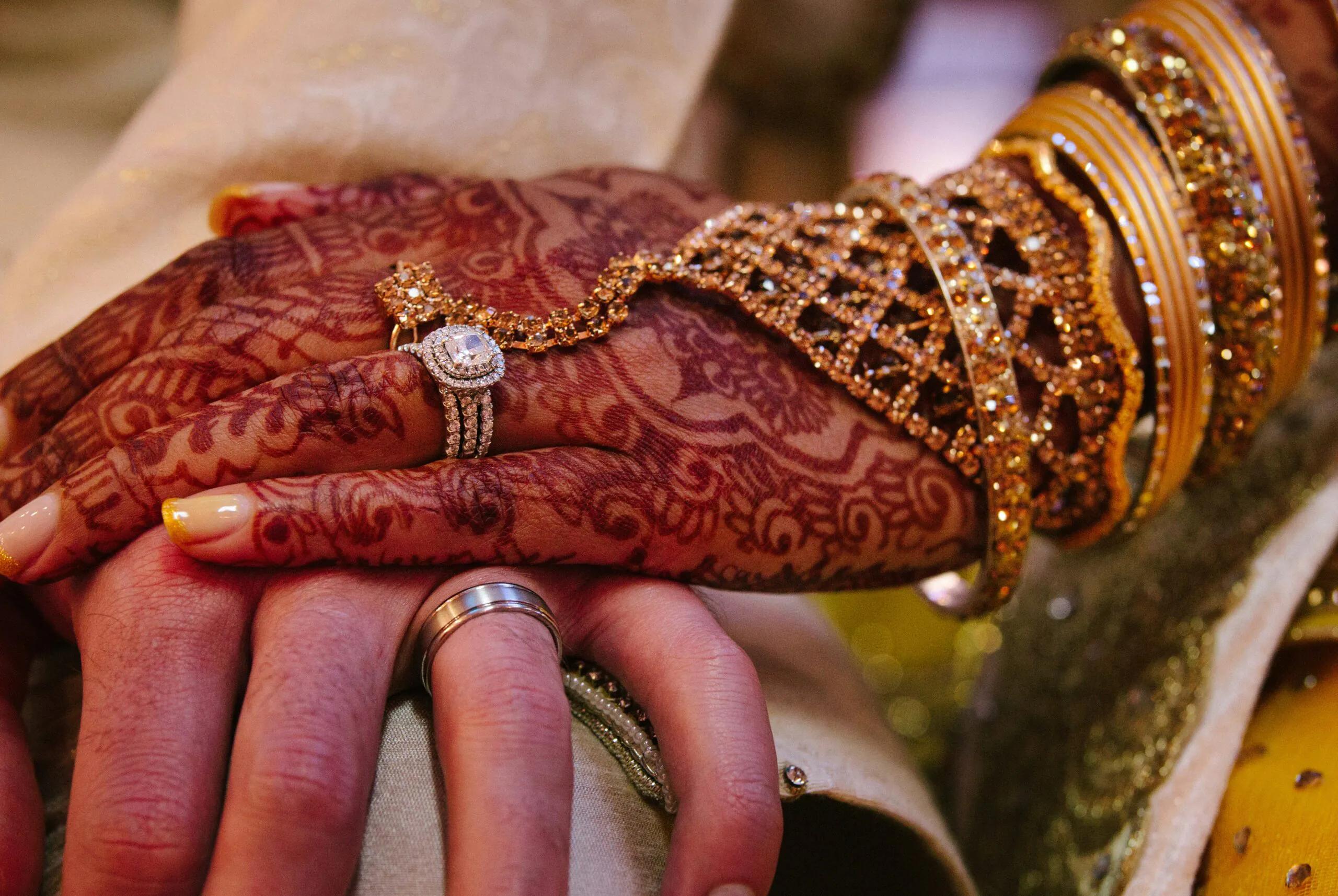
Maryland, Virginia, and D.C. are home to large immigrant communities who often married overseas under Islamic tradition. At the time of marriage, couples typically negotiate what is called the Mahr, Mehr, or Mehrieh — commonly described to Americans as a form of dowry.
Under Islamic law, the mahr is a gift, or promise of a gift, from husband to wife, often negotiated shortly before marriage and put in writing. It may take the form of gold, cash, or land. The wife may demand payment at any point during the marriage or upon its dissolution.
In many Middle Eastern countries, a wife’s rights on divorce are far more limited than a husband’s, and only the husband may typically initiate a divorce. The mahr serves as her financial security and, often, as leverage to obtain her husband’s consent to divorce. It plays a very different role overseas than it does once a family relocates to Maryland or elsewhere in the U.S.
The mahr is often set high to reflect the groom’s commitment, regardless of whether he can actually afford to pay it years later. For example, an Iranian immigrant who promised his wife 70 gold coins at marriage may have no realistic way to pay that amount after years working a blue-collar job in the U.S.
These problems compound when a wife seeks her mahr in a Maryland divorce, on top of a share of marital property, spousal support, or child support. The result can leave the husband with far less than he would otherwise receive under equitable distribution — or nothing at all.
Complications are common: the mahr may exceed the marital estate, have been negotiated by the parties’ parents rather than the spouses, never been reduced to writing, or have been agreed to decades earlier under very different financial circumstances. No two cases look alike.
Courts in Maryland, Virginia, and the District of Columbia must balance respect for religious and cultural tradition against a fair division of marital assets when a mahr claim arises in divorce. Clients who married under Islamic tradition often ask: “Can I collect my Mehr or Mehrieh when I file for divorce?” The honest answer is: it depends on how the court views the mahr. There are good arguments both for and against enforcing it under American divorce law.
Arguments for Mehr or Mehrieh
- It Is a Gift. Maryland, Virginia, and D.C. treat an engagement ring as a completed gift made in contemplation of marriage, not subject to division in divorce. Under similar reasoning, a mahr — such as a promise of gold coins — could be treated the same way.
- It Is a Contract. Mahr agreements are often in writing. Maryland, Virginia, and D.C. courts have shown willingness to treat a written mahr as an enforceable civil contract where it meets ordinary contract-formation requirements.
Arguments against Mehr or Mehrieh
- Same as Alimony. Alimony is designed to provide a dependent spouse financial support after divorce — the same purpose the mahr traditionally served. Maryland, Virginia, and D.C. courts have been reluctant to award both alimony and a full mahr.
- Fairness. A spouse should not receive the full benefit of marital property division and alimony under Maryland, Virginia, or D.C. law, and then separately collect her mahr abroad.
Other jurisdictions take a similar approach, generally applying the ‘neutral principles of law’ doctrine: courts will enforce a mahr as an ordinary civil contract if it meets standard contract-formation requirements — consideration, voluntariness, and no fraud, duress, or unconscionability — without having to interpret religious doctrine. Maryland addressed this directly in Nouri v. Dadgar, 245 Md. App. 324, 226 A.3d 797 (2020), where the Court of Special Appeals applied this same neutral-principles approach, treating the mahr as an ordinary contract rather than a religious obligation and focusing on whether it was validly formed. Dadgar confirms that Maryland courts will give civil effect to a mahr, but only to the extent it can be enforced like any other contract.
Mehr, Mehrieh, and Dowry in Virginia, D.C., Pennsylvania, Delaware, and West Virginia
Spouses in Virginia, D.C., Pennsylvania, Delaware, or West Virginia face similar questions. These states likewise look first to whether the mahr satisfies ordinary contract-law requirements — a clear, voluntary agreement with adequate consideration and no fraud, duress, or unconscionability — before enforcing it as a civil contract. Dadgar, while not binding outside Maryland, may offer persuasive guidance to courts in these neighboring states applying the same approach. Because precedent remains limited and outcomes are fact-specific, anyone considering divorce in this region should consult an attorney about how local law is likely to apply to their mahr before filing.
Courts across Maryland and these neighboring jurisdictions often acknowledge mahr as a religious tradition but decline to enforce it, or reduce what is owed, for reasons including:
- The total marital assets may be worth less than the amount of the mahr;
- The mahr agreement was negotiated shortly before the marriage, leaving little time for meaningful negotiation;
- The parties did not have the benefit of independent legal advice;
- The agreement was negotiated by the parties’ parents rather than the spouses themselves, raising questions about whether it is binding on the couple.
Because outcomes are uncertain, mahr litigation can be costly. Many cases resolve with the wife accepting a roughly equal division of property and alimony in the U.S., while separately pursuing her mahr in a country like Iran, where a husband may be required to pay before he can leave.
The best way to avoid this uncertainty is to address the mahr directly in a Marital Settlement Agreement executed in the U.S., so both spouses’ expectations are clearly defined.
The law in this area continues to evolve, both internationally — notably in Canada — and across Maryland, Virginia, D.C., Pennsylvania, Delaware, and West Virginia. We will continue to update this blog as new developments arise.