Mental Health Privilege & Maryland Divorce Blog Law Series – Part 3

This blog series discusses mental health privilege (the confidentiality a client has/clients have with their mental health provider) in contested family litigation (such as divorce and custody).

To recap:

A “privilege” is the legal right to protect a communication from disclosure & to keep information confidential.  Privileged information cannot be used in contested litigation unless the privilege is waived.

Privilege attaches when certain types of professionals provide mental health services.  Not everyone who is a “counselor” or “therapist” qualifies as a privileged provider.

This blog explores “the what” – what is protected by the privilege.

Maryland’s 3 mental health privilege statutes* protect the following from disclosure in family law litigation:

Patient-therapist privilege (§9-109*) and Client-psychiatric nursing specialist or professional counselor (§9-109.1):

  • Communications relating to diagnosis or treatment of the patient or client; or
  • Any information that by its nature would show the existence of a medical record of the diagnosis or treatment
    (language above is paraphrased and slightly different but the gist is the same)

Social worker-client (§9-121*):

  • Communications made while the client was receiving counseling
  • Any information that by its nature would show that such counseling occurred

The scope of privilege for licensed certified social workers is so much broader that the fact someone is in therapy and name of their LCSW is privileged.  The fact of therapy & name of provider easily creep up in family law litigation:  parents’ calendars, phone records, EOBs/explanation of benefits, credit card receipts, checks, electronic payment accounts.

Key takeaways:

  • Not all privileges are created equal
  • The type of provider determines scope of privilege
  • Inadvertent disclosure is a pitfall with the LCSW privilege (§9-121*)

To keep this blog mercifully short, the next explores what’s not privileged (which gets juicy).

*Md. Code Ann., Cts. & Jud. Proc. (2019 Rep. Vol.)
Mental Health Privilege & Maryland Divorce Blog Law Series – Part 2

This blog series discusses mental health privilege (the confidentiality a client has/clients have with their mental health provider) in contested family litigation (such as divorce and custody).

To recap:

A “privilege” is the legal right to protect a communication from disclosure & to keep information confidential.  Privileged information cannot be used in contested litigation unless the privilege is waived.

This blog explores “the who” – who provides privileged services.

Maryland’s 3 mental health privilege statutes* apply to the following types of providers:

  1. Licensed psychologist (§9-109(a)(2))
  2. Psychiatrist (§9-109(a)(4))
  3. Professional counselor (§9-109.1(a)(3))
  4. Psychiatric-mental health nursing specialist (§9-109.1(a)(4))
  5. Licensed certified social worker (§9-121(a)(3))

But one has to look at what’s beneath the title.

A “licensed psychologist” means someone licensed to practice psychology under the laws of Maryland.

But, the definition of “psychiatrist” doesn’t require Maryland licensure.  (And irksomely refers to someone who “devotes…his time to the practice of psychiatry”.)

To understand who is a “professional counselor”, one has to go to Health Occupations Article Title 17 for the definition of “counselor.”  Only to find that “counselor” is not generally defined (§17-101), but is an included term in the following definitions:

  • Certified professional counselor
  • Certified professional counselor – marriage and family therapist
  • Certified supervised counselor – alcohol and drug
  • Certified associate counselor – alcohol and drug
  • Certified professional counselor – alcohol and drug
  • Licensed graduate alcohol and drug counselor
  • Licensed graduate marriage and family therapist
  • Licensed graduate professional counselor

So, is §9-109.1’s privileged provider the narrower “professional counselor” or all the types of “counselor” defined in Title 17?  As with licensed psychologists, the definitions of “certified” and “licensed” in §17-101 all mean, broadly speaking, authorized by Maryland’s State Board of Professional Counselors and Therapists.

§9-109.1 doesn’t specify that a psychiatric-mental health nursing specialist must be licensed or certified by the State of Maryland, but:

  • Does use the term “registered nurse”, which in Health Occupations §8-101 requires either Maryland licensure or multistate licensure
  • Allows a master’s degree (with or without a baccalaureate degree)
  • Allows certification by the American Nurses’ Association or body approved by the Board of Nursing

Finally, §9-121 requires licensure as a “certified social worker” under Health Occupations Title 19.  Perplexingly, Health Occupations §19-101’s definitions do not define “certified social worker” or “social worker”.  Though they do define “license” and “certified” and refer to the practice of “certified social work” and “certified social work-clinical”.  So, there’s that.

If you’ve read this long, here’s your reward with key takeaways…

  • What a provider calls themselves does not mean it’s privileged: Go beneath the title
  • Privilege starts with the provider & whether they qualify as privileged
  • “Counselor” and “therapist” in a provider’s title does not automatically mean privileged
    • So, who may not be:
      • School counselor
      • School psychiatrist
      • Art therapist
      • Pastoral counselor
      • Behavioral counselor
    • That’s why you have to go beneath the title

But there’s more!
Next step (and blog) – what is privileged?

*Md. Code Ann., Cts. & Jud. Proc. (2019 Rep. Vol.)

JGL Attorneys David Bulitt, Bridget Cardinale, Virginia (Gia) Grimm, Reza Golesorkhi, Jay Holland, Veronica Nannis, Lindsay Parvis, and Paul Riekhof will be attending the 2024 MSBA Legal Summit and Annual Meeting that takes place at the Roland E. Powell Convention Center in Ocean City, MD from June 5-7, 2024. Gia Grimm, Veronica Nannis, and Jay Holland will be hosting a Qui Tam CLE session called “Might Your Client be a Whistleblower? Identifying and Pursuing False Claims Act Cases,” on Wednesday, June 5th from 3-4pm. 

More about the 2024 MSBA Legal Summit:

For the last 30+ years, the Maryland State Bar Association’s Legal Summit has brought together Maryland legal professionals from across the state, in every professional segment and every career stage.

Legal Summit allows our community to connect, learn and move the profession forward while enjoying the sun and relaxation of Ocean City, Maryland. MSBA’s signature event continues to provide unique instruction and thought leadership from distinguished colleagues and leaders from all over the state — in every practice area.

Mental Health Privilege & Maryland Divorce Blog Law Series – Part 1

A “privilege” is the legal right to protect a communication from disclosure & to keep information confidential. In action, this means that privileged information cannot be used in contested litigation unless the privilege is waived.  Waiver means opening the door to others on confidential communications and information.

A privilege may be created by rule, statute, or case law.  And, privileges created by rule or statute are often developed by case law interpreting them.

Maryland has 3 statutes that create mental health privileges:

  1. §9-109 Patient-therapist privilege*
  2. §9-109.1 Communications between client and psychiatric-mental health nursing specialist*
  3. §9-121 Social worker-client communications*

When I think about privilege, I start with the licensure of the provider.  Then I look for the statute that applies to that type of license.  Sometimes, providers have multiple licenses (for example, psychologist and licensed certified social worker-clinical/LCSW-S), so more than one statute applies.

There are a number of ways to check & cross-check licensure:

  • Looking up the provider online
  • Confirming licensure on Maryland State license verification websites
  • Asking the provider

Key takeaways from this introduction:

  • Privilege is confidentiality
  • Privilege waiver – or not – is a decision that requires thought in contested family litigation
  • Waiver means opening the door to outsiders to access confidential communications and information

Next up:  Who provides privileged mental health services?

*Section references to Md. Code Ann., Cts. & Jud. Proc. (2019 Rep. Vol.)

Erika Jacobsen-White is First Shift Justice Project’s 2024 Board Chair and JGL is a silver sponsor of their major fundraising project “Dance Like a Mother.” As in previous years, Erika will DJ at the event to be held on May 17th from 6pm to 1am at Wunder Garten, in NE Washington, DC. “First Shift Justice is a truly inspiring organization that helps low-wage working parents and caregivers in the DC Metro Area assert their workplace rights to prevent job loss.”

Click to donate to Dance Like a Mother: A Benefit for First Shift Justice Project.

The D.C. Trial Lawyers Foundation and Trial Lawyers Association held their 67th Annual Awards Dinner on May 11, 2024 at Nationals Park.

JGL was a Silver sponsor for this event. Attorneys Drew LaFramboise, Erika Jacobsen-White, and Bridget Cardinale attended.

JGL Principal, Lindsay Parvis, will speak on the virtual Divorce and Family Law Roundtable on May 7th, from 12:00-1:00pm on Zoom. The topic of this meeting is “2024 Maryland Family Law Legislative Update: The Good, The Bad and the Ugly.”

Lindsay Parvis is the Co-Chair of the Legislative Committee of the Maryland State Bar Association’s Family Law Section Council.

Registration: This is a free program, but you must pre-register by emailing your registration request to Roundtable member, Carol Randolph, at NewBCarol@verizon.net. The Zoom link will be sent out the week of the event.

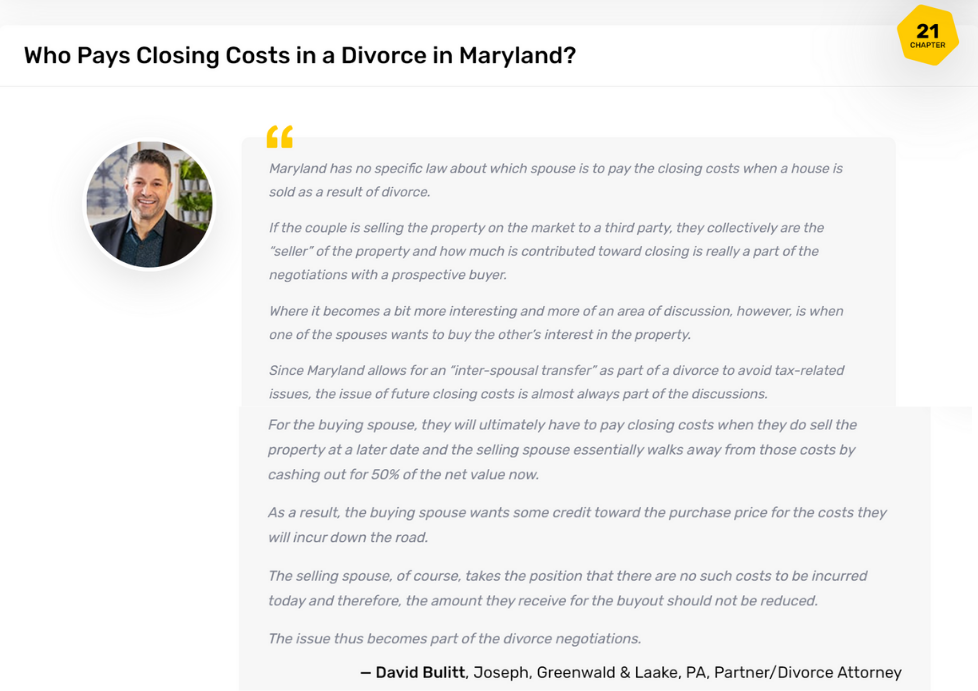
David Bulitt quoted as a Family Law expert in the Real Estate Bees article “How Much Are Closing Costs?

Dbulitt Real Estate Bees

On April 23, 2024, the Federal Trade Commission (FTC), voted (3 to 2) to essentially stop employers from issuing new non-compete agreements for most workers in private industry.

Non-compete agreements are agreements that employees sign that prohibit them from changing jobs or working for competitors. These agreements, with rare exceptions, are not something that employees want to sign, but something they must sign as a condition of their employment in order to get a job.

A court challenge is expected by the Chamber of Commerce, among others. This matter could well land before the Supreme Court. If it does, the National Labor Relations Board’s prohibition on employers forcing employees to waive their rights to participate in class actions through mandatory arbitration agreements, the Court will probably strike down the rule. The good news for those that live in a handful of states and the District of Columbia is that there are either complete bans on non-compete agreements or they are restricted to certain high-income earners. Before signing any such agreement, please check to see if you are in one of those jurisdictions.

JGL Principal, Reza Golesorkhi, is featured in Modern Luxury DC Magazine’s “Charitable Leadership Spotlight” in their April edition. 

Read the full interview from Modern Luxury DC Magazine (PDF)

JGL Principal Lindsay Parvis along with two other experts in Custody Proceedings – Syretta R. James, Ph.D. of Respire Behavioral Health and The Honorable Joanie Raymond a Frederick County Circuit Court Family Magistrate – presented a class to the Judicial College. The class entitled “It Takes a Village: Complex Parenting Cases,” this class was designed to encourage judges and magistrates to look at different types of experts to make child-centered decisions in custody cases. To read more about the class brought to the Judicial Class, read this article “Family Law, Matters: It Takes a Village – Experts in Custody Proceedings,” featured in the PGCBA News Journal.          

JGL Principal David Bulitt authored an article featured in the Washington Family Magazine entitled “Divorce and the Special Needs Child.” (PDF)