Learn more about JGL partner Veronica Nannis from her recent interview with Of Counsel. Her discussion covers topics from how she got into the legal world to some of her favorite cases in her career. Read the full interview by clicking on the image below.


Of Counsel Thumb

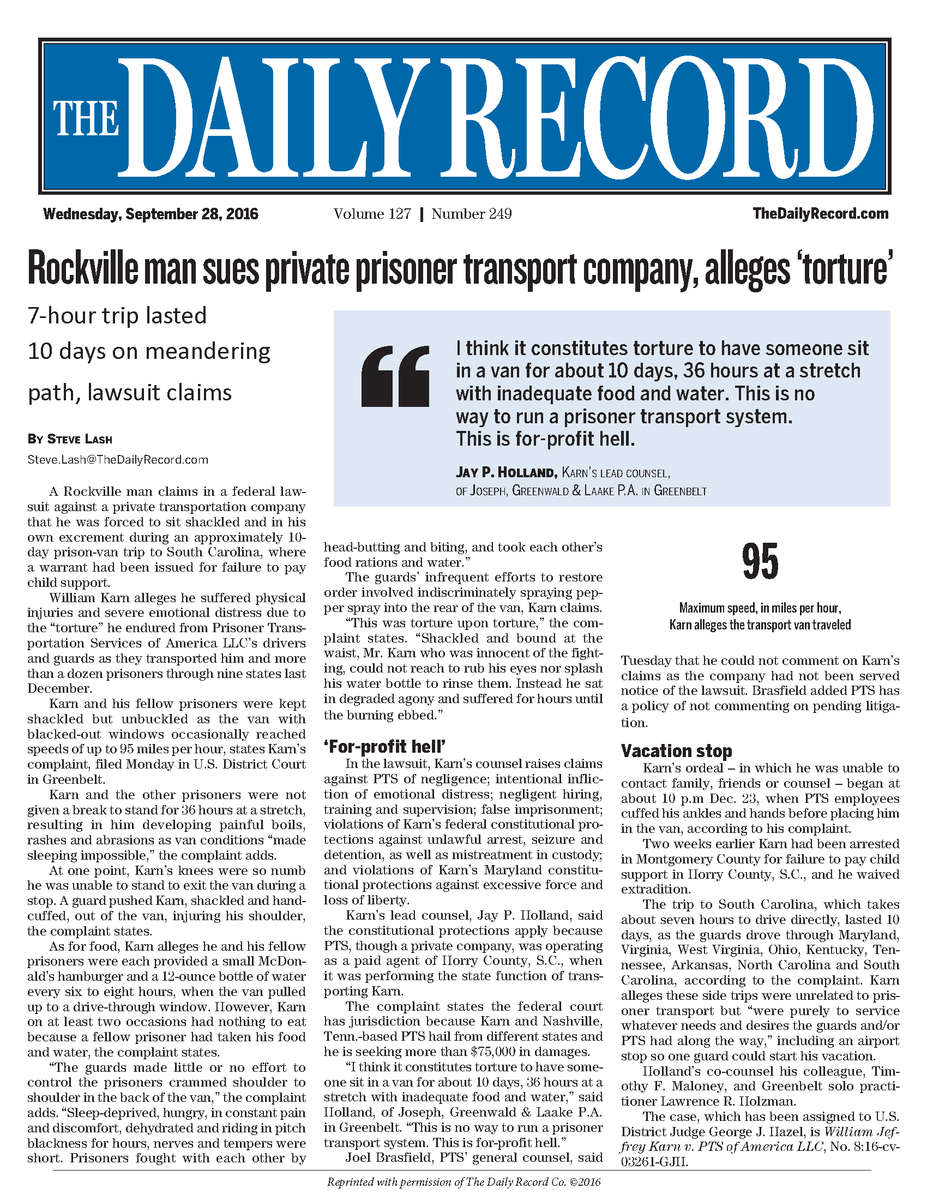
JGL’s Jay Holland and Tim Maloney are representing a Rockville man that has filed suit against a private prisoner transport company for the physical harm and emotional distress he claims to have endured during a 10-day, nine state van ride.  The story was recently covered by The Daily Record.

Private Prison Transport Case

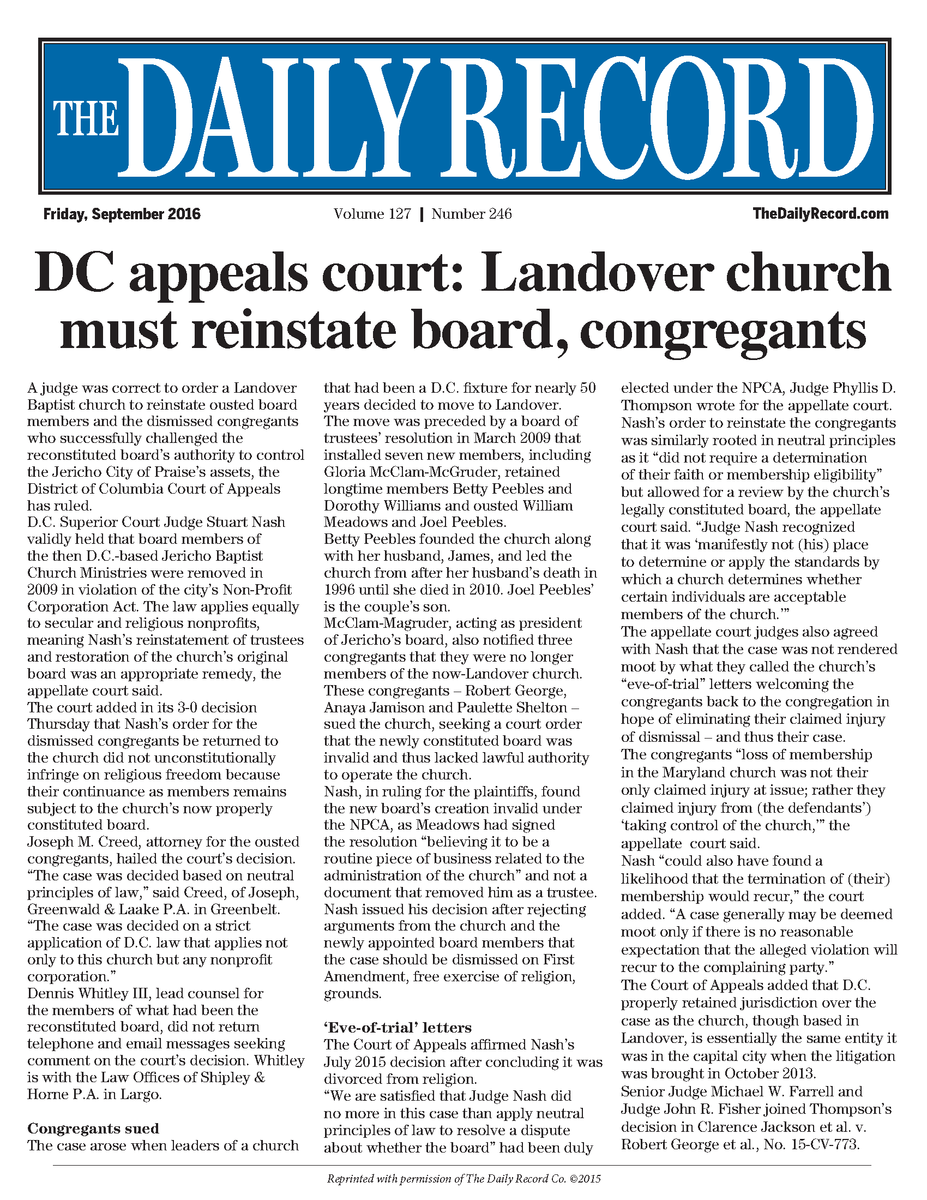
The legal team led by JGL’s Joe Creed won a DC Appeals Court case that has reinstated the Board of Trustees and secured the future for Jericho Baptist Church.  The story was featured in a recent article in The Daily Record.

Jericho Baptist Church 0


A complaint that our firm has just filed in the U.S. District Court for the District of Maryland tells a powerful and appalling story of the abuse of an American citizen, convicted of no crime, at the hands of employees of PTS of America, Inc., a Nashville-based private company that is in the business of transporting prisoners and detainees.

We assert in the complaint, which we filed September 26, 2016, that our client, William Karn, underwent horrific conditions of abuse for 10 days last December while he was being transported by six PTS employees from Montgomery County, Maryland, to South Carolina. Mr. Karn was picked up in Maryland to face a trial in South Carolina, some seven hours away by car under normal circumstances, on charges of failing to pay child support. He had not yet been tried, much less convicted.

Mr. Karn, we say in the complaint, was shackled, and, along with 14 other prisoners, was stuffed into a crowded van that took a circuitous nine-day trip to South Carolina in conditions that were beyond disgusting. He and the other prisoners were forced to live in proximity to their bodily wastes, found it impossible to sleep, and were given one small hamburger and one bottle of water every six hours. They were forced to remain in the van for 36 hours at a time. Mr. Kern suffered permanent injuries and severe emotional distress, we assert.

Many of the detours, through nine different states, were made entirely for the convenience of the PTS employees who were driving and had nothing to do with the transport of the prisoners. In one instance, we assert, the drivers went out of their way just to send one of the drivers on a vacation.

“Along the way, human conditions in the back of the van deteriorated,” we say in the complaint, which was filed by Joseph, Greenwald & Laake partners Jay Holland and Timothy Maloney. “The guards made little or no effort to control the conduct of the prisoners crammed shoulder to shoulder in the back of the van. Sleep-deprived, hungry, in constant pain and discomfort, de-hydrated and riding in pitch-blackness for hours, nerves and tempers were short.  Prisoners fought with each other by head-butting and biting, and took each other’s food rations and water.

On behalf of Mr. Karn, we assert claims of negligence; intentional infliction of emotional distress; negligent hiring, training and supervision; false imprisonment; unlawful arrest, seizure and detention; mistreatment in custody; and violation of the Maryland Declaration of Rights by the use of excessive force and loss of liberty.

We hope and believe that this case will shed additional light on the national scandal of the privatization of much of the nation’s justice system. In August 2016, Deputy Attorney General Sally Yates announced that the U.S. Justice Department plans to end its reliance on private prisons after officials concluded that these facilities are both less safe and less effective at providing correctional services than those run by the government.

“The appalling conditions that our client was subjected to are unworthy of this nation,” Mr. Holland said. “We hope that the case will not only provide some recompense for Mr. Kern but will also make state governments have second thoughts about entrusting private companies like PTS with their citizens’ constitutional rights.”


Joseph Greenwald & Laake (JGL) is pleased to announce that the District of Columbia Court of Appeals affirmed a decision by the DC Superior Court, returning control of Jericho Baptist Church Ministries, Inc. to the original Board of Trustees, which includes the Rev. Joel Peebles, whose parents founded the church more than 50 years ago.  JGL represented the plaintiffs in this matter, Robert George, Paulette Shelton, and Anaya Jamison, who are longtime members of Jericho. The plaintiffs had their membership rights terminated by a purported board that seized control of Jericho in 2010, but which has now been removed from power. Joseph Creed headed up the trial team for JGL.

This decision is the culmination of nearly six years of litigation for control of Jericho Baptist Church Ministries, Inc., also known as Jericho City of Praise, a large church based in Landover, Maryland. The decision affirms a previous ruling by the DC Superior Court, which returned control of the church entity to the original Board of Trustees, including the Rev. Joel Peebles.

According to Joseph Creed of Joseph Greenwald & Laake, “We are very pleased with the court’s decision. This church has a great history in the community. We are happy this lawsuit reinstated our clients’ membership and returned control to the proper board.”

The Court of Appeals concluded that, although courts generally have limited authority to resolve intra-church disputes, the court properly did so here because the decision was based on neutral principles of law that apply to all nonprofit corporations incorporated in the District of Columbia. The court ruled that the purported board was not properly elected in accordance with DC law, and therefore the original board remains in place.

The decision also establishes circumstances under which ousted church members may sue to seek reinstatement of their membership, including where they suffer harm that is unique to them (and does not apply to the membership as a whole) and have a personal financial stake in the dispute, such as through the payment of tithes and offerings.

In addition to Mr. Creed, the JGL trial team included Timothy F. Maloney, as well as Ronald Cherry, D’Ana Johnson, and Nadia Patel of the law firm of Bonner, Kiernan, Trebach & Crociata, LLP.  The case is Clarence Jackson et al. v. Robert George et al.  JGL also represents Joel Peebles and William Meadows, members of the board that was returned to power.


About Joseph Greenwald & Laake

For more than 40 years, Joseph, Greenwald & Laake, P.A. is one of the most trusted law firms serving Maryland, the District of Columbia and Virginia. Known for its commitment to community, confidence and character, Joseph, Greenwald & Laake is the leader in bringing suits against local governments and school systems. The firm represents a variety of clients, including victims, individuals, small businesses and multimillion-dollar corporations. From simple to complex legal needs, the firm is prepared to deliver strategic solutions with high standards.

The Supreme Court of Maryland concluded that a trial judge’s declaration of a mistrial over the defendant’s objection due to the client’s absence based on a medical emergency barred retrial under the Double Jeopardy clause of the Fifth Amendment to the U.S. Constitution.

The reported decision in State v. Hart, 449 Md. 246 (2016) is available here (PDF).

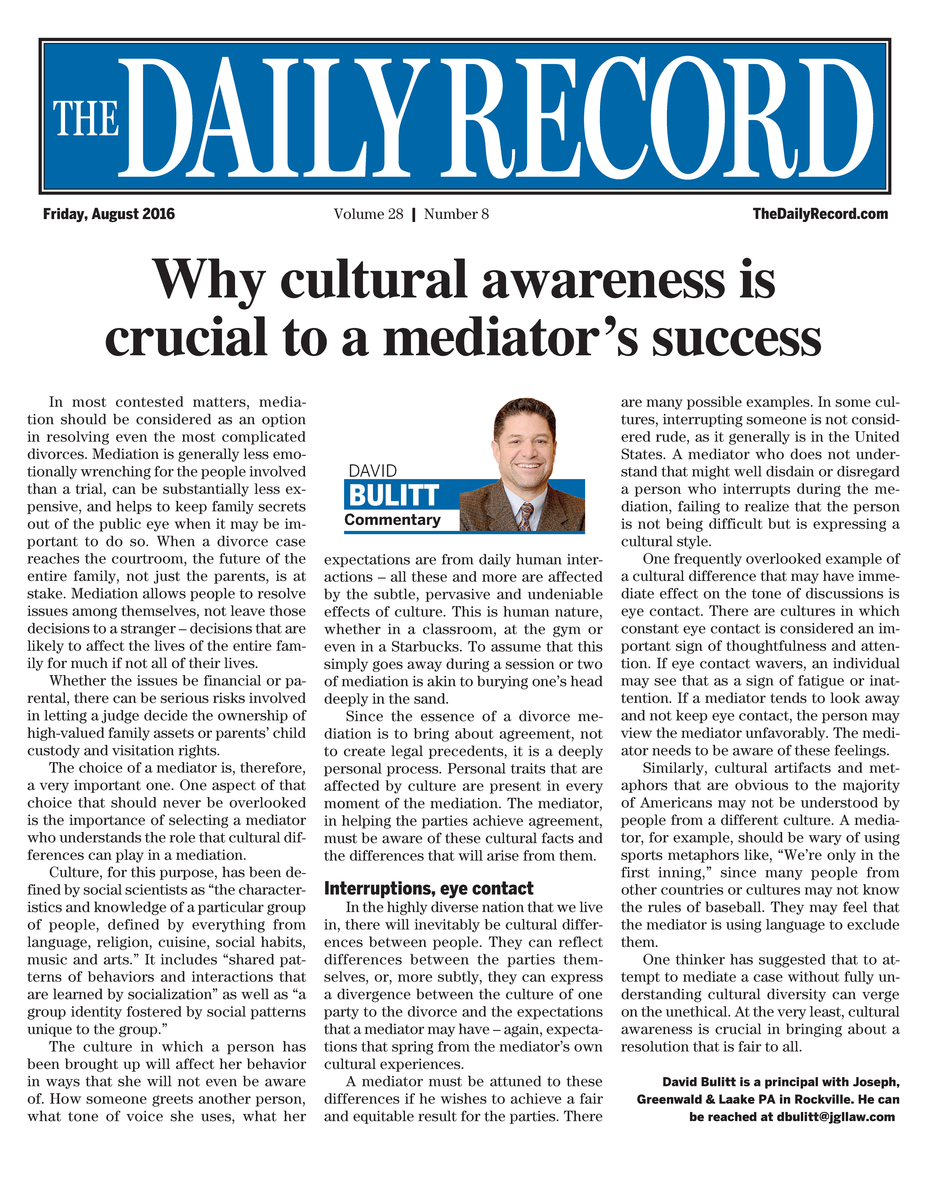
David Bulitt wrote a full page commentary for the Maryland Daily Record titled “Why Cultural Awareness is Crucial to a Mediator’s Success.” Click on the image below to read the article. 1x1bhcu

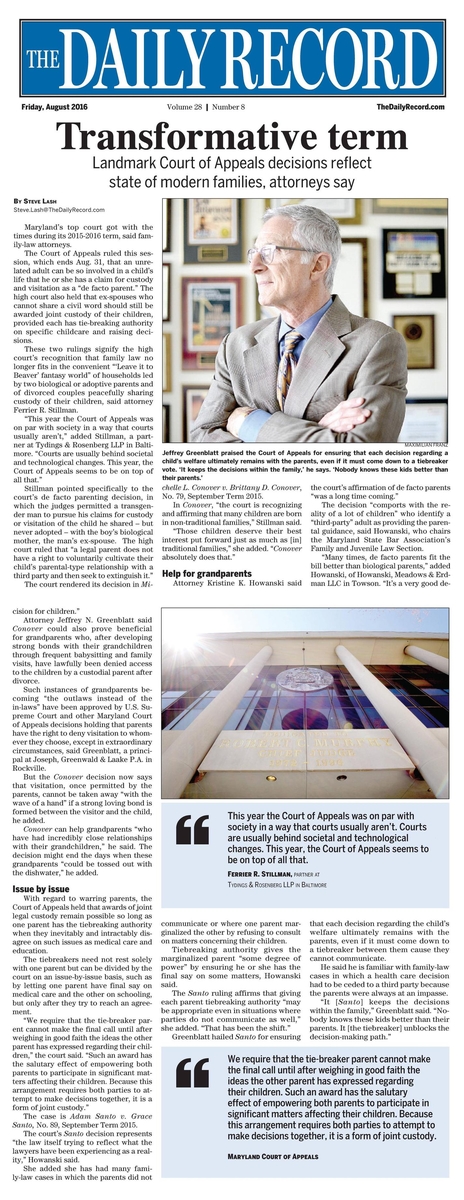
Jeffrey Greenblatt’s perspecive of recent Maryland rulings about child custody was featured in the Daily Record’s article titled “Transformative Term.” “It keeps the decisions within the family. Nobody knows these kids better than their parents.” Click on the image below to read the entire story.  

Yhqjely

How To Identify Niche Online Business Opportunities 1 1

Significant economic indicators continue to support the proposition that new business startup activity is on the rise.  On August 4, 2016, the Kauffman Foundation released the 2016 Kauffman Index of Startup Activity, its highly respected annual report which focuses on new business creation. 

According to the Index, entrepreneurship in the United States rose for the second year in a row in 2015.  This a mere two years after the index plunged to its lowest level in two decades.

The foundation noted, in a development of particular significance, that more new businesses are being started out of desire as opposed to need. 

The Index contains additional data supporting the positive trend. The foundation noted that job creation numbers issued by the federal Bureau of Labor Statistics show that 889,000 jobs were created by new establishments in the last quarter of 2015 alone – the highest job creation number for new establishments since early 2008.

In addition, the Kauffman Index contains the following key developments:

  • The number of new business owners increased by more than 15 percent since 2014, with about 330 out of every 100,000 adults in the nation becoming entrepreneurs for the first time.
  • An increase in women-owned business is helping to drive the trend; 260 out of every 100,000 women are now new entrepreneurs, up from 220 out of 100,000 in 2014. The “gender gap” for entrepreneurs decreased from 2014 to 2015.
  • Latino entrepreneurship is significantly on the rise, with 21 percent of new entrepreneurs being Latino in 2015, as opposed to only 10 percent in 1996.

The share of startups run by African Americans and Asian Americans has also increased during that period.

  • The startup rate is at its highest since early 2008.
  • Although the trend is positive, startup activity is still well below pre-2008 recession levels.

“Understanding what is happening to our country’s startups and entrepreneurs is essential to any policymaker hoping to accelerate and expand on the recent progress we have seen in entrepreneurial activity,” said Senator David Vitter (R-LA), chairman of the U.S. Senate Small Business Committee, who wrote the foreword to the current Kauffman Index report.

Here’s to a continuation of the trends reported in the Index.   Good news for small business is good news for everyone — as small business drives the American economy.  

The 2016 Kauffman Index of Startup Activity can be viewed in full here: http://www.kauffman.org/microsites/kauffman-index/reports/startup-activity.

Stethoscope Medical Malpractice

I am Andrew E. Greenwald, partner at Joseph Greenwald & Laake, and am a former chair of the American Association for Justice Birth Trauma Litigation Group. I have given over 100 lectures to trial lawyers and other groups and have recovered $1 million or more in over 50 cases for victims of medical negligence. I am dedicated to serving victims of medical negligence, and much of my practice is devoted to just that.

People who suffer injuries or death from improper medical treatment can, in many instances, file a lawsuit against a physician, hospital or other provider for medical negligence. Here are some of the basics about medical negligence.

What is medical negligence? Medical negligence occurs when a person is injured or dies as a result of improper medical treatment.

What happens at an initial meeting between a victim of medical negligence and me, an attorney who represents victims? We have a detailed conversation about how the injury occurred and discuss the client’s concerns. I explain what is involved in pursuing a case and provide an initial evaluation. There is no charge for this meeting.        

How is a medical malpractice case investigated? The client signs a HIPAA form so that I can get a complete copy of the relevant medical records. After a detailed review, I consult with medical experts in the area of concern. Findings are shared with the client.

How is a medical malpractice case pursued? What happens next? If the case is meritorious, with my client’s consent, a lawsuit or claim is filed. A life care plan of the client’s future needs is prepared. An economist is engaged to assess lost income and project the cost of the client’s future needs. Witnesses are questioned and the court sets a trial date. The parties may agree to mediate.

What is mediation? An independent mediator meets with all parties to try to resolve the case. Each side has an opportunity to present its case to each other and to the mediator. The parties are separated into different conference rooms, and the mediator discusses the case with each side hoping to reach a settlement.

The following is a checklist to help you gather relevant records, history, and other information that your attorney will need.

  • BACKGROUND INFORMATION
    • a chronological list of key events that led to the injury
    • a list of persons who were present or who spoke to any of the health care providers
    • a statement about how and when you first became aware that there may have been inappropriate treatment
  • THE DOCTORS
    • the names of all doctors and hospitals involved
    • the name of the doctor or doctors’ professional practice(s)
  • YOUR MEDICAL HISTORY
    • your brief medical history
    • a list of all medications prescribed
    • a statement of what you were told by the doctor or the hospital about your treatment
    • a copy of the medical records from the treating doctor and from the hospital (this should include the entire chart, not just a summary)
  • BIRTH INJURY (www.dcbirthinjurylawyer.com)
    • your prenatal records
    • records from other pregnancies and deliveries
    • your labor and delivery records
    • the fetal monitor strip
    • the baby’s newborn records
    • the pediatrician’s records
    • reports of any radiology studies such as MRI or CAT scans
    • all records relating to any testing done on the child
  • DEATH
    • a copy of the autopsy report

If you cannot obtain these records, your attorney can obtain them for you.

Transgender Students Civil Rights


Jay P. Holland, a principal in the Firm’s Civil Litigation Group and chair of the firm’s Labor, Employment, and Qui Tam Whistleblower practice, was quoted on July 25, 2016, in an article in Law360 concerning the National Basketball Association’s decision to relocate its 2017 All-Star game out of Charlotte, N.C. The NBA took that action in opposition to the state’s new law that restricts transgender people from using the bathroom of their choice.

The NBA’s decision is regarded as an important test case of the ability of a sports league to effect social change. The controversial law prevents municipalities in North Carolina from enacting anti-discrimination measures and forces people to use bathrooms based on the gender listed on their birth certificate.

North Carolina Gov. Pat McCrory has sharply criticized people and groups that he said were outsiders trying to pressure the political leaders of his state into changing the law.

“Left-wing special interest groups have no moral authority to try [to] intimidate the large majority of American parents who agree in common-sense bathroom and shower privacy for our children,” McCrory said in a statement. “American families should be on notice that the selective corporate elite are imposing their political will on communities in which they do business, thus bypassing the democratic and legal process.”

Holland responded to these concerns in a quote that appeared in the Law360 article.

“I find it a little absurd or disingenuous for the governor to say that the NBA is not respecting the democratic process,” Holland said in the article. “They feel that a jurisdiction is acting in a discriminatory fashion, and they are entitled to say: ‘We don’t want to give you our business.’ ”

Holland was also quoted in the article as saying that the state law “puts the NBA in a very difficult and untenable position,” had the All-Star game gone on as planned. “I frankly don’t know how North Carolina intends to enforce the law. Are they going to have bathroom monitors? And even then how are they going to know?”

The full Law360 article can be found at: http://www.law360.com/articles/821106/nba-tests-power-to-effect-change-with-all-star-game-move. (Please be advised that due to Intellectual Property rights full access to these articles may require registration or purchase of a subscription.)

Images 3

In most contested matters, mediation should be considered as an option in resolving even the most complicated divorces. Mediation is generally less emotionally wrenching for the people involved than a trial, can be substantially less expensive, and helps to keep family secrets out of the public eye when it may be important to do so. When a divorce case reaches the courtroom, the future of the entire family, not just the parents, is at stake.  Mediation allows people to resolve issues amongst themselves, not leave those decisions to a stranger – decisions that are likely to affect the lives of the entire family for much if not all of their lives.  Whether the issues be financial or parental, there can be serious risks involved in letting a judge decide the ownership of high-valued family assets or parents’ child custody and visitation rights.

The choice of a mediator is therefore a very important one in any divorce that is going to be mediated. One aspect of that choice that should never be overlooked is the importance of selecting a mediator who understands the role that cultural differences can play in a mediation.

Culture, for this purpose, has been defined by social scientists as “the characteristics and knowledge of a particular group of people, defined by everything from language, religion, cuisine, social habits, music and arts.” It includes “shared patterns of behaviors and interactions that are learned by socialization” as well as “a group identity fostered by social patterns unique to the group.”

The culture in which a person has been brought up will affect her behavior in ways that she will not even be aware of. How someone greets another person, what tone of voice she uses, what her expectations are from daily human interactions – all these and more are affected by the subtle, pervasive and undeniable effects of culture.  This is human nature – it is all of us, whether in a classroom, at the gym or even in a Starbucks.  To assume that this simply goes away during a session or two of mediation is akin to burying one’s head deeply in the sand.

Since the essence of a divorce mediation is to bring about agreement among human beings, not to create legal precedents, it is a deeply personal process. Personal traits that are affected by culture are present in every moment of the mediation. The mediator, in helping the parties achieve agreement, must be aware of these cultural facts and the differences that will arise from them.

In the highly diverse nation that we live in, there will inevitably be cultural differences between people. They can reflect differences between the parties themselves, or, more subtly, they can express a divergence between the culture of one party to the divorce and the expectations that a mediator may have – again, expectations that spring from the mediator’s own cultural experiences.

A mediator must be attuned to these differences if he wishes to achieve a fair and equitable result for the parties. There are many possible examples. In some cultures, interrupting someone is not considered rude, as it generally is in the United States. A mediator who does not understand that might well disdain or disregard a person who interrupts during the mediation, failing to realize that the person is not being difficult but is expressing a cultural style.

One frequently overlooked example of a cultural difference that may have immediate effect on the tone of discussions is eye contact. There are cultures in which constant eye contact is considered an important sign of thoughtfulness and attention. If eye contact wavers, an individual may see that as a sign of fatigue or inattention. If a mediator tends to look away and not keep eye contact, the person may view the mediator unfavorably. The mediator needs to be aware of these feelings.

Similarly, cultural artifacts and metaphors that are obvious to the majority of Americans may not be understood by people from a different culture. A mediator, for example, should be wary of using sports metaphors like “we’re only in the first inning,” since many people from other countries or cultures may not know the rules of baseball. They may feel that the mediator is using language to exclude them.

One thinker has even suggested that to attempt to mediate a case without fully understanding cultural diversity can verge on the unethical. At the very least, cultural awareness is crucial in bringing about a resolution that is fair to all.